
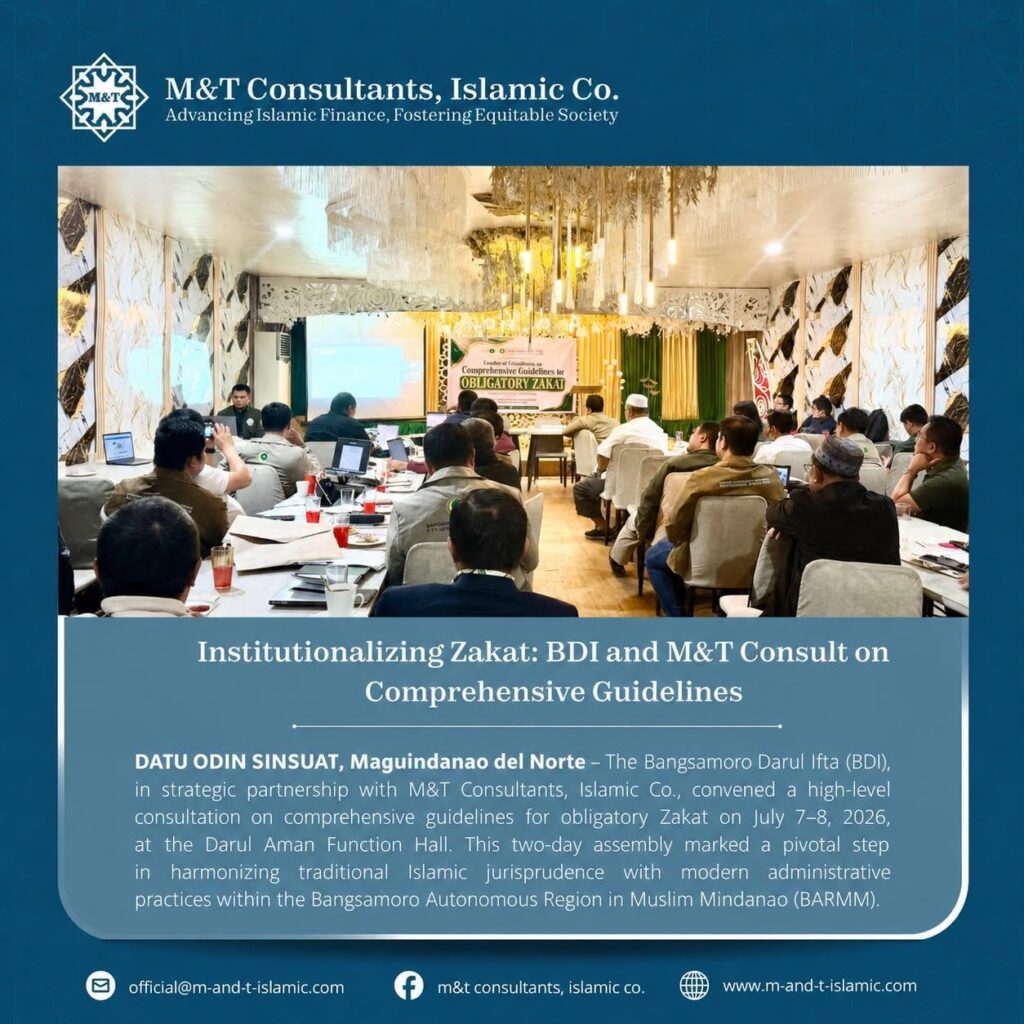
DATU ODIN SINSUAT, Maguindanao del Norte – The Bangsamoro Darul Ifta (BDI), in strategic partnership with M&T Consultants, Islamic Co., convened a high-level consultation on comprehensive guidelines for obligatory Zakat on July 7–8, 2026, at the Darul Aman Function Hall. This two-day assembly marked a pivotal step in harmonizing traditional Islamic jurisprudence with modern administrative practices within the Bangsamoro Autonomous Region in Muslim Mindanao (BARMM).
The event drew a distinguished assembly of religious and academic leaders, including representatives from Hay’atul ‘Ulama, Lujnatul Ulya, and the Da’wah Committee & Masajid Affairs among others.
Setting the Vision
BDI Executive Director Sheikh Marhan Borhan opened the event by underscoring the necessity of standardizing Zakat collection and distribution. The Bangsamoro Mufti, His Eminence Sheikh Abdulrauf A. Guialani, provided spiritual guidance, while Fatwa Division Chief Sheikh Camaludin Esmail presented the technical rationale for the guidelines to ensure strict Shariah alignment.
Global Expertise and Advocacy
The workshop was further enriched by the expertise of resource persons, including Sheikh Kaharudin Midtimbang and Sheikh Lucman L. bin Usman Imam, who provided critical perspectives on how Zakat systems are successfully optimized in other jurisdictions. These insights were complemented by Hadji Makhtar Abdullah, CEO of the Association of Shariah Advisors in Islamic Finance (ASAS), who presented on “Contemporary Zakat Models, the Role of Shariah Scholars, and Institutional Approaches to Islamic Economic Development”. Hadji Makhtar emphasized that institutionalization is essential to transform a religious obligation into a national development instrument, noting that Shariah scholars anchor institutional legitimacy while corporate structures deliver reach and efficiency. He further highlighted that ASAS-style advisory standards are vital to translate fiqh into operational governance, with a strategic goal of fostering financial inclusion rather than competing with commercial banking.
M&T is collaborating with ASAS to strengthen capacity building for Shariah advisory services throughout the Philippines.
Historical Legacy and Evolution
A significant portion of the consultation focused on the evolution of Zakat management, presented by Shk Abdulrahman Abbas of Lujnatul Ulya. The session highlighted how the organization was instrumental in shaping the current state of the Bangsamoro by institutionalizing Zakat collection. He detailed how, under the recognition of the late Amir Ustadh Salamat Hashim, Lujnatul Ulya became the foundational institution tasked with implementing Zakat practices. This mandate was crucial in consolidating the trust of the Bangsamoro people, helping to mitigate fragmented collections and ensuring Zakat served its purpose in poverty alleviation, a legacy that serves as a cornerstone for contemporary governance structures.
A Whole-of-Stakeholder Approach
Parliament Speaker His Excellency Mohammad S. Yacob in his message of support emphasized the need for strict adherence with Qur’an and Sunnah, and modern, technology-based system to enhance trust in th system. “The government must provide the enabling mechanisms, our Ulama must safeguard the Shariah integrity, and our technical experts must ensure transparency and build public trust,” Speaker Yacob remarked, calling for a unified, whole-of-stakeholder approach to ensure the system’s longevity and effectiveness.