
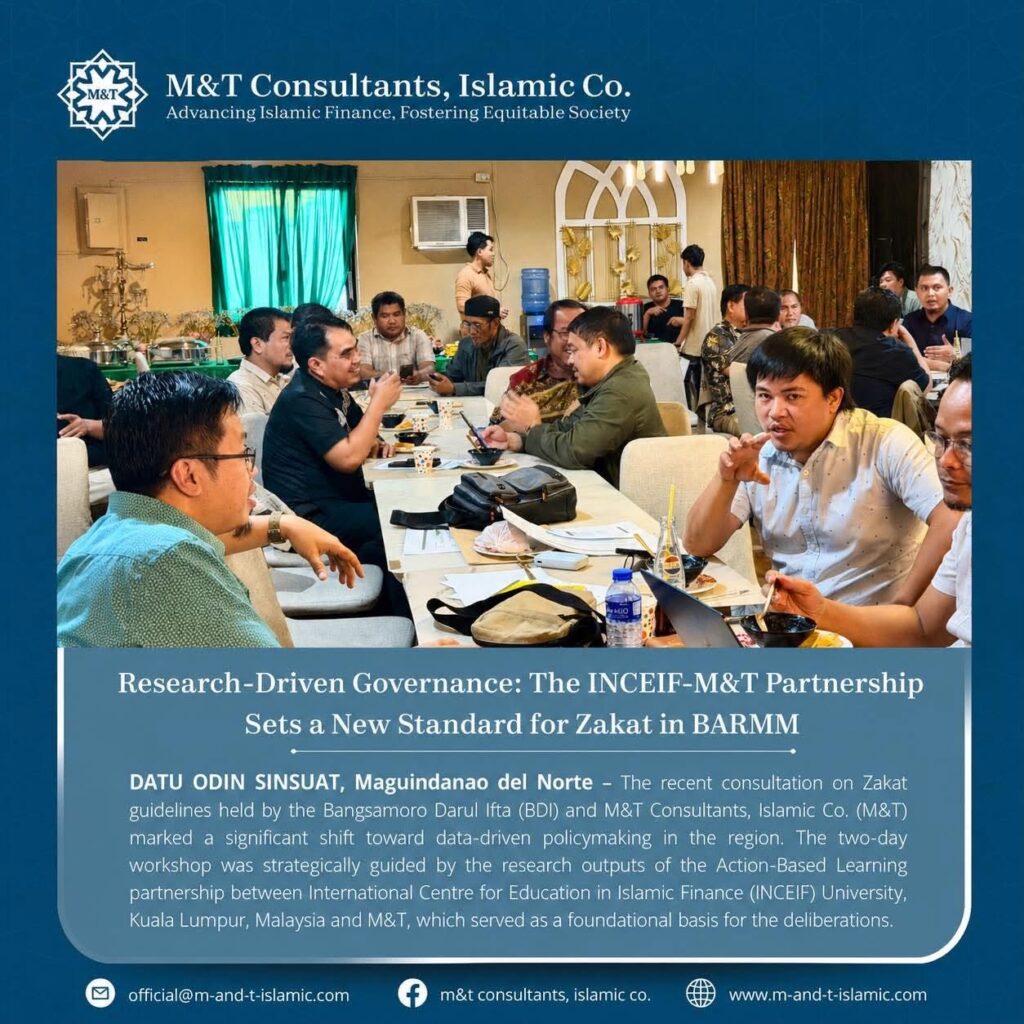
DATU ODIN SINSUAT, Maguindanao del Norte – The recent consultation on Zakat guidelines held by the Bangsamoro Darul Ifta (BDI) and M&T Consultants Islamic Co. (M&T) marked a significant shift toward data-driven policymaking in the region. The two-day workshop was strategically guided by the research outputs of the Action-Based Learning partnership between INCEIF University and M&T Consultants, which served as a foundational basis for the deliberations.
From Academic Research to Actionable Policy
The workshop was designed to integrate research results into practical administrative frameworks. Participants utilized two seminal studies as key references to guide their discussions:
1. Zakat Governance in BARMM: This research served as a baseline for evaluating the region’s current institutional roles and regulatory capacities.
2. Zakat-linked Islamic Microfinance Models: This study provided a technical foundation for exploring alternative, Shariah-compliant financing structures capable of thriving within the Bangsamoro context.
Addressing Core Dimensions of Zakat Administration
By applying these research outputs, M&T, through the workshop successfully guided stakeholders through an interactive analysis of four critical pillars of Zakat administration:
1. Legal and Institutional Structure: Participants clarified the mandates of regulatory bodies to ensure a cohesive legal framework.
2. Collection and Distribution Governance: The sessions addressed the development of efficient, Shariah-compliant systems for managing Zakat funds.
3. Oversight and Accountability: Discussions emphasized the implementation of robust mechanisms to safeguard the integrity of the system.
4. Digital Readiness: The dialogue explored how the region can prepare for and integrate modern, technology-based financial solutions to improve service delivery.
Through this collaboration, the INCEIF-M&T partnership is providing the BDI and other stakeholders with the necessary expertise to develop a roadmap for Zakat administration that is both deeply rooted in Shariah principles and aligned with modern global best practices.